
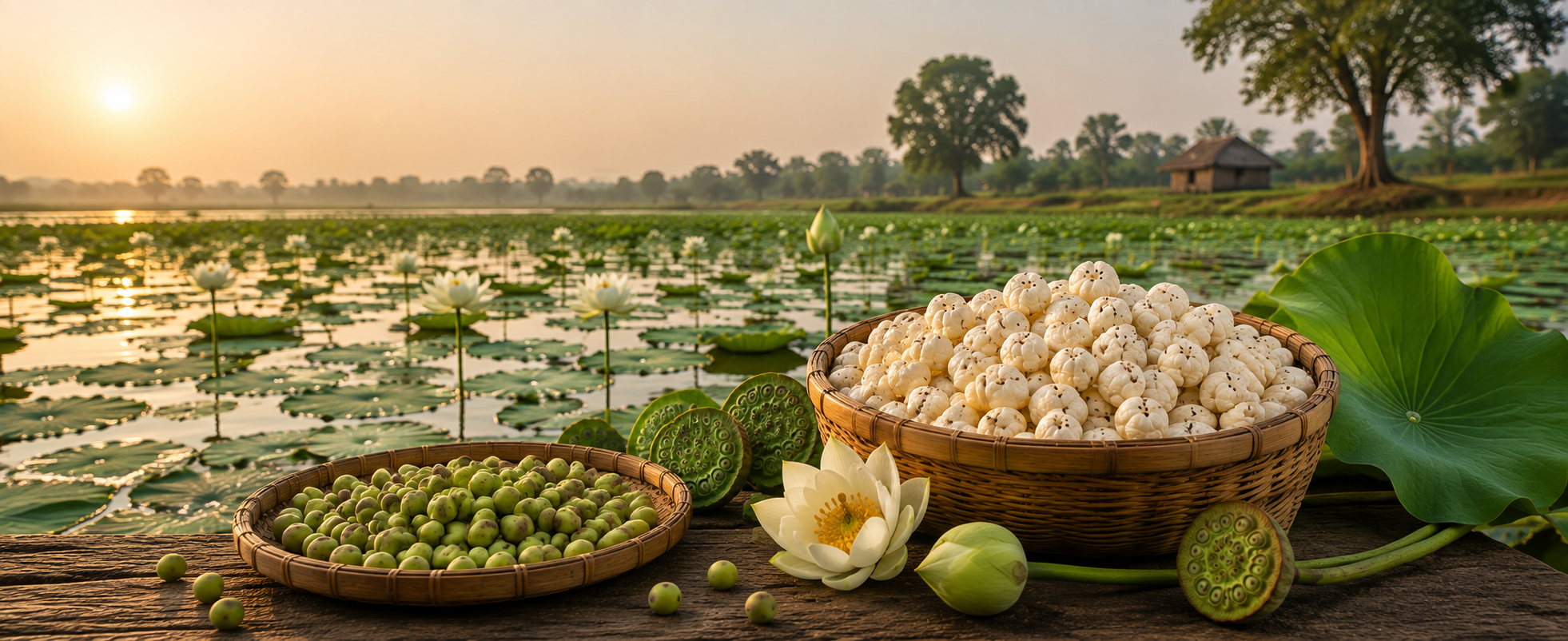
When we enjoy a bowl of roasted Makhana, we usually think about its light texture, crunch and flavour. But the story of Mithila Makhana starts much earlier.
It starts with farmers, water, seeds and the agricultural knowledge developed around one of India's distinctive aquatic crops.
Makhana, commonly known as fox nut, comes from the aquatic plant Euryale ferox. Bihar has a particularly strong connection with Makhana cultivation, especially the Mithila region. The ICAR–National Research Centre for Makhana in Darbhanga was established in 2002 because of the crop's historical, cultural and economic importance in Mithila.
So, how is Mithila Makhana cultivated?
Unlike crops that grow in ordinary dry fields, Makhana is an aquatic crop. Traditional cultivation takes place in ponds and other suitable water bodies, while improved field-based cultivation methods are also being developed and supported.
At MithilaRam, we believe that knowing how a product reaches your table makes its story more meaningful. So in this article, we are taking a closer look at the journey of Mithila Makhana—from cultivation to the Makhana we eventually enjoy as a snack.
What Is Mithila Makhana?
Before looking at cultivation, it is useful to understand what we mean by Mithila Makhana.
Makhana is the edible popped seed of the aquatic plant Euryale ferox. The term Mithila Makhana connects the product with its geographical identity in Bihar.
The Government of India's Geographical Indications Registry lists Mithila Makhana as a registered GI, with Bihar recorded as its geographical area. The GI certificate was issued on August 16, 2022.
This geographical connection is important because Makhana is not simply a generic packaged snack. It has a strong agricultural and cultural relationship with the Mithila region.
Understanding how the crop is cultivated gives us another way to appreciate that connection.
Where Is Mithila Makhana Cultivated?
Makhana has traditionally been cultivated in water bodies across parts of Bihar.
The crop is particularly associated with northern Bihar and the Mithila region. ICAR identifies Makhana as an important aquatic crop commercially cultivated mainly in the Mithila region of Bihar.
The Bihar government's Makhana development programmes currently cover multiple districts, including Darbhanga, Madhubani, Purnia, Katihar, Saharsa, Supaul and several other districts.
Traditionally, farmers have used ponds and other suitable water bodies. Modern cultivation is also moving toward more organised field systems.
This development is important because cultivation methods can influence productivity, labour requirements and the overall Makhana value chain.
Why Is Makhana Cultivated in Water?
Makhana is fundamentally different from common dryland crops because it is an aquatic plant.
Its natural growing habit is associated with water.
Traditional cultivation can take place in ponds, wetlands and other suitable stagnant water bodies. Research and government programmes have also explored field-based cultivation where water levels can be managed appropriately.
ICAR has documented field cultivation systems in which Makhana can be grown at relatively shallow water depths, demonstrating that cultivation is not limited to traditional deep ponds.
This adaptability has helped researchers and farmers explore ways to make Makhana cultivation more organised and productive.
Step 1: Choosing a Suitable Growing Area
The cultivation journey begins with the growing environment.
Traditional Makhana cultivation is associated with suitable ponds and other water bodies. The water needs to remain available for the crop throughout its growing cycle.
The exact conditions depend on the cultivation system, local environment and farming practices.
Today, Bihar is also promoting field-system Makhana cultivation. The state's 2025–26 horticulture programme specifically supports farmers interested in adopting field cultivation and includes assistance related to improved seed and other inputs.
This is an important development because it shows how traditional Makhana farming is gradually being complemented by more structured cultivation methods.
Step 2: Selecting Quality Planting Material
The next important consideration is planting material.
Traditional cultivation has often depended on locally available seeds. However, research institutions have worked on improved varieties and better seed production.
For example, ICAR developed and released Swarna Vaidehi, an improved Makhana variety, in 2013. The variety was developed for use in Bihar and other suitable states and was also found suitable for field-based cultivation.
More recently, Bihar's 2025–26 horticulture programme has included the production and distribution of improved Makhana varieties, including Swarna Vaidehi and Sabour Makhana-1.
Better planting material can play an important role in improving the consistency and productivity of cultivation.
Step 3: Planting and Establishing the Crop
Once the growing area and planting material are ready, the Makhana crop is established.
The exact planting process depends on whether the farmer is using a traditional pond system or a field-based cultivation system.
In field cultivation, water depth and planting arrangements can be managed more systematically.
Research by ICAR has demonstrated field-based Makhana cultivation, including systems where Makhana can be followed by other crops during the year.
This type of research is important because it can help farmers make better use of agricultural land while diversifying production.
Step 4: Managing the Water and Crop
Water management is one of the major differences between Makhana cultivation and ordinary field agriculture.
The Makhana plant needs an appropriate aquatic environment to develop.
Farmers therefore need to monitor the growing conditions and manage the crop according to the local cultivation system.
This requires practical experience.
Makhana cultivation is not simply a matter of putting seeds into water and waiting for the harvest. Farmers have to work with seasonal conditions, crop development and the characteristics of their particular growing environment.
The current ICAR research centre also identifies changing climatic conditions, crop-protection issues and limited mechanisation among the challenges facing the Makhana sector.
Step 5: The Makhana Plant Develops
As the crop grows, the Makhana plant develops its characteristic large leaves that float on the water.
The plant eventually produces flowers and fruits.
Inside these fruits are the seeds from which edible Makhana is eventually produced.
This is an interesting part of the process because the final product looks very different from the plant and seed from which it comes.
The white, puffed Makhana we see in stores is the result of several stages of cultivation and post-harvest processing.
Step 6: Harvesting the Makhana Seeds
Harvesting is one of the most important stages of Makhana cultivation.
The seeds develop within the fruits and need to be collected from the water.
Traditional Makhana harvesting can be physically demanding and labour-intensive.
ICAR has highlighted the labour-intensive nature of Makhana cultivation and harvesting, as well as the need for greater mechanisation in the sector.
This is an important part of the story that consumers may not see when purchasing a finished packet.
A simple-looking snack can involve substantial agricultural work before it ever reaches a processing unit.
Step 7: Drying the Harvested Seeds
The harvested seeds do not immediately become the white Makhana kernels we know.
They need to undergo post-harvest processing.
Drying is an important stage before the seeds move toward roasting and popping.
Proper post-harvest handling matters because the quality of the raw material can influence the quality of the finished product.
This is why the Makhana value chain extends well beyond cultivation.
It includes harvesting, drying, storage, processing, grading and eventually packaging.
Step 8: Roasting and Popping
One of the most distinctive parts of Makhana processing is popping.
The raw seeds are processed through roasting and popping to produce the familiar expanded Makhana kernel.
ICAR explains that the seeds are traditionally roasted and popped to obtain the edible product commercially known as Makhana.
This transformation is remarkable.
A small seed becomes a light, expanded kernel with a very different appearance and texture.
Traditional popping has involved significant manual labour, which is why mechanisation has become an important area of research and development.
Step 9: Sorting and Grading
Once the Makhana has been popped, it can be sorted and graded.
Different kernels can vary in size, shape and appearance.
Grading helps organise the product according to quality and intended use.
The final product may then be supplied as plain Makhana or used as the base for roasted and flavoured snacks.
This is one of the points where agricultural production connects directly with the modern food industry.
Step 10: Turning Makhana Into a Modern Snack
After cultivation and processing, Makhana can be prepared in several ways.
Plain Makhana
Plain Makhana can be used for cooking, homemade recipes or roasting at home.
Roasted Makhana
Roasting provides a convenient way to enjoy Makhana as a ready-to-eat snack.
Flavoured Makhana
Seasonings and flavour combinations can turn Makhana into a modern snack with different taste profiles.
The Bihar government's agribusiness programme specifically recognises processed Makhana, ready-to-eat Makhana and different flavoured Makhana products as areas for value addition.
For brands like MithilaRam, this creates an opportunity to introduce a traditional regional product to consumers in formats that fit modern lifestyles.
Traditional Makhana Farming and Modern Cultivation
Makhana cultivation is evolving.
For generations, farmers have relied on traditional knowledge and labour-intensive practices. At the same time, agricultural research is introducing improved varieties, cultivation techniques and processing technologies.
The Bihar government's current Makhana programmes focus on areas such as improved seed production, field cultivation, equipment, training and farmer support.
The National Makhana Board programme also focuses on strengthening the wider value chain, including production, seed distribution, training, post-harvest management, branding, market development, exports and certification.
This combination of traditional knowledge and agricultural innovation could play an important role in the future of Makhana.
Why Mechanisation Matters
One of the biggest challenges in the Makhana sector is labour-intensive cultivation and processing.
ICAR has specifically discussed mechanisation of Makhana popping as a way to improve worker health and livelihoods.
Mechanisation does not mean replacing the story of traditional Makhana farming.
Instead, appropriate technology can help make difficult stages of cultivation and processing more efficient and safer.
This is particularly relevant as demand for Makhana grows in India and international markets.
The People Behind Mithila Makhana
It is easy to focus on the finished packet and forget the people who make the product possible.
Farmers are at the beginning of the Makhana value chain.
Their work is followed by harvesting, processing, grading, trading, packaging and distribution.
The ICAR–National Research Centre for Makhana notes that Makhana contributes to the livelihoods of farmers, processors, traders and entrepreneurs in the region.
For us at MithilaRam, this wider value chain is an important part of the story.
When we talk about Makhana, we are also talking about the agricultural communities and skills behind it.
Why Mithila Makhana's Origin Matters
The geographical identity of Mithila Makhana gives the product an important connection to Bihar.
The official GI Registry records Mithila Makhana as a registered GI product, with Bihar as the geographical area and a certificate date of August 16, 2022.
This recognition adds another layer to the product's story.
For consumers, it provides an opportunity to learn not only about what Makhana is, but also about where this particular regional product comes from.
For us at MithilaRam, that regional connection is central to the brand.
From Mithila's Water Bodies to Modern Kitchens
The journey can be summarised simply:
Suitable growing environment
↓
Planting material
↓
Crop establishment
↓
Water and crop management
↓
Flower and fruit development
↓
Seed harvesting
↓
Drying and post-harvest handling
↓
Roasting and popping
↓
Sorting and grading
↓
Packaging and value addition
↓
Makhana reaches consumers
Every stage adds something to the final product.
That is why the next time you open a packet of Makhana, it is worth remembering that the story began much earlier than the packaging.
How MithilaRam Looks at Makhana
At MithilaRam, our focus is not simply on putting Makhana into a packet.
We want to help consumers understand the product and its connection with Mithila.
Our range includes different ways of enjoying Makhana, including plain, roasted and flavoured varieties.
We believe modern food products can be convenient while still respecting their agricultural and regional roots.
For us, the story of Makhana begins with its origin and continues through cultivation, processing and finally into the homes of consumers.
That is the perspective we want to bring to the MithilaRam brand.
The Journey Behind Every Makhana
The story of Mithila Makhana begins with agriculture.
It continues through water management, crop cultivation, harvesting, drying, popping, grading and processing before finally reaching the consumer.
For us at MithilaRam, this journey is worth sharing because it gives Makhana a context that goes beyond the finished snack.
From the water bodies of Bihar to modern Indian kitchens, Mithila Makhana carries a story of agriculture, regional identity and changing food habits.
And that story begins with the farmers who cultivate it.
Explore MithilaRam
Discover MithilaRam's range of plain, roasted and flavoured Makhana and find a format that suits your everyday snacking preferences.
Frequently Asked Questions
How is Mithila Makhana cultivated?
Mithila Makhana comes from an aquatic crop traditionally cultivated in ponds and other suitable water bodies. Improved field-based cultivation methods are also being promoted in Bihar.
Where is Mithila Makhana cultivated?
Makhana is strongly associated with Bihar, particularly the Mithila region. Bihar's current Makhana programmes cover numerous districts across the state.
Is Makhana grown in ponds?
Yes. Traditional Makhana cultivation is associated with ponds and suitable stagnant water bodies. Researchers have also developed field-based cultivation systems.
What plant does Makhana come from?
Makhana comes from the seeds of the aquatic plant Euryale ferox.
How does Makhana become puffed?
The harvested seeds undergo post-harvest processing, including drying, roasting and popping. The popping process produces the expanded kernels commonly sold as Makhana.
Why is Bihar important for Makhana?
Bihar has a major agricultural, cultural and economic connection with Makhana. The ICAR–National Research Centre for Makhana is located in Darbhanga, reflecting the importance of the crop to the Mithila region.
Is Mithila Makhana GI registered?
Yes. The official Geographical Indications Registry lists Mithila Makhana as registered, with Bihar as its geographical area. The certificate date is August 16, 2022.
Is Makhana cultivation changing?
Yes. Alongside traditional cultivation, research and government programmes are supporting improved varieties, field cultivation, equipment, training, processing, mechanisation and broader value-chain development.
Why Mithila Makhana Is Special: From Bihar’s Tradition to Modern Snacking
Top 7 Health Benefits of Roasted Makhana vs. Fried Snacks