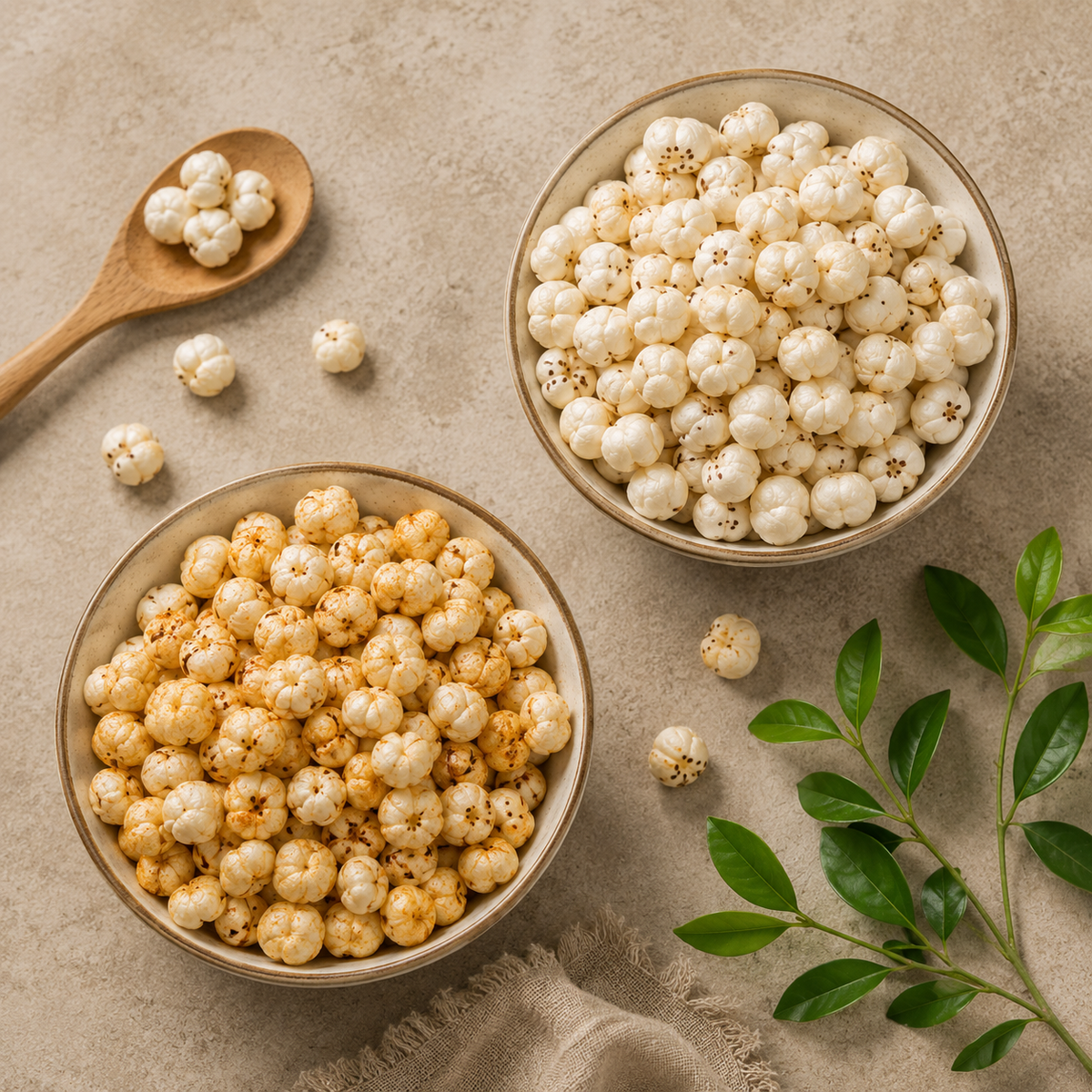
Makhana has become a popular ingredient for both traditional Indian recipes and modern snacking. But when you start shopping for it, you may come across different options, including raw or plain Makhana and ready-to-eat roasted Makhana.
So which one should you buy?
The answer depends on how you want to use it.
If you enjoy preparing your own snacks and recipes, plain Makhana gives you more control over roasting, seasoning and cooking. If convenience is your priority, roasted Makhana is ready to eat and can be enjoyed straight from the pack.
Neither option is automatically right for everyone.
In this guide, we'll compare raw and roasted Makhana based on preparation, texture, flavour, convenience, storage, cooking uses and buying considerations so you can make a choice that suits your needs.
What Is Raw Makhana?
Raw Makhana, often called plain or unroasted Makhana, is the puffed Makhana product before it is prepared as a ready-to-eat roasted snack.
It has a mild taste and a light texture.
Because it isn't already seasoned, you can decide how you want to prepare it.
You can:
-
Roast it at home
-
Add your own spices
-
Use it in recipes
-
Prepare sweet dishes
-
Prepare savoury dishes
-
Control the amount of seasoning
-
Experiment with different flavours
Plain Makhana is therefore useful when you want an ingredient rather than a finished snack.
What Is Roasted Makhana?
Roasted Makhana is Makhana that has been roasted to develop a crisp texture.
It can be prepared at home or purchased as a ready-to-eat packaged product.
Depending on the product, roasted Makhana may contain additional ingredients such as oil, salt, spices or flavouring.
This is why it is important to read the ingredient list when comparing packaged products.
Ready-to-eat roasted Makhana is particularly convenient because there is no need to roast or season it before eating.
Simply open the pack and enjoy.
Raw Makhana vs Roasted Makhana at a Glance
Here's a simple comparison:
| Feature | Raw/Plain Makhana | Roasted Makhana |
|---|---|---|
| Preparation | Requires preparation | Often ready to eat |
| Seasoning | You choose | Already seasoned if flavoured |
| Texture | Prepared according to roasting method | Usually crisp and ready to eat |
| Flavour | Mild | Can be savoury or flavoured |
| Cooking | Good for recipes | Mainly convenient for snacking |
| Customisation | High | Depends on the product |
| Convenience | Requires some preparation | Very convenient |
| Best for | Home cooking and experimentation | Quick snacking |
The right choice depends on your priorities.
Which Is Better for Everyday Snacking?
If your main goal is a quick snack, roasted Makhana is usually the more convenient option.
You don't need to heat a pan, roast the Makhana or prepare a seasoning blend.
Ready-to-eat roasted Makhana can be useful for:
-
Office breaks
-
Travel
-
Evening snacking
-
Home
-
Study breaks
-
Snack boxes
-
Sharing with family
However, convenience doesn't mean every roasted Makhana product has the same ingredients or nutritional profile.
If you're buying packaged Makhana regularly, check the label.
Look at:
-
Ingredients
-
Serving size
-
Nutrition information
-
Salt/sodium
-
Added oils
-
Flavouring ingredients
This gives you a clearer idea of what you're purchasing.
When Is Raw Makhana a Better Choice?
Plain Makhana may be a better option if you enjoy preparing food yourself.
For example, you might prefer plain Makhana if you want to:
-
Control the seasoning
-
Experiment with different recipes
-
Choose your preferred cooking fat
-
Prepare sweet or savoury dishes
-
Roast different batches with different flavours
Plain Makhana is also useful as a pantry ingredient because you can decide how you want to use it later.
Can You Roast Raw Makhana at Home?
Yes.
Roasting Makhana at home is relatively simple.
A basic method involves heating a pan over low to medium-low heat, adding the Makhana and roasting it while stirring regularly.
The most important thing is to avoid relying solely on a fixed cooking time.
Instead, check the texture.
Take one piece out, allow it to cool slightly and taste it.
A properly roasted piece should be crisp and crunchy rather than soft or chewy.
If you'd like a detailed step-by-step method, read:
How to Roast Makhana at Home: Easy Tips for Crispy Fox Nuts
What Does Raw Makhana Taste Like?
Plain Makhana has a relatively mild taste.
This makes it easy to combine with different ingredients.
You can create a snack based on your preferred flavour profile.
For example:
Simple
Salt and black pepper.
Spicy
Chilli powder, cumin and other spices.
Fresh and herby
Mint or pudina seasoning.
Smoky
Barbecue-style seasoning.
Tangy
Seasonings containing ingredients such as amchur, depending on your recipe.
The advantage is that you're starting with a relatively neutral ingredient.
What Does Roasted Makhana Taste Like?
Roasting changes the eating experience.
The texture becomes crisp, while the flavour can become more pronounced.
If the Makhana is sold as a flavoured product, the seasoning will also influence the final taste.
For example, a barbecue Makhana may have a smoky and savoury profile, while a peri peri variety may have a more pronounced spicy character.
This makes roasted Makhana appealing to people who want a snack with a stronger flavour without having to prepare it themselves.
Plain vs Flavoured Roasted Makhana
It's also useful to distinguish between plain roasted Makhana and flavoured roasted Makhana.
Plain roasted Makhana
The Makhana is roasted and may have minimal seasoning.
This keeps the flavour relatively simple.
Flavoured roasted Makhana
Additional ingredients are used to create a particular flavour.
These may include spices, salt, oils and other seasonings.
Always check the ingredient list and nutrition panel because formulations differ between products and brands.
Which Makhana Is More Convenient?
For convenience, ready-to-eat roasted Makhana has an obvious advantage.
With plain Makhana, you need to:
-
Measure the Makhana.
-
Heat your pan.
-
Roast it.
-
Prepare seasoning if desired.
-
Mix the seasoning.
-
Allow it to cool.
With ready-to-eat roasted Makhana:
-
Open the pack.
-
Enjoy.
This difference can matter when you're busy or away from home.
Which One Gives You More Control?
Plain Makhana wins here.
When you start with plain Makhana, you control:
-
Roasting time
-
Heat level
-
Oil or ghee
-
Salt
-
Spices
-
Flavour intensity
-
Portion size
This can be particularly useful if you enjoy experimenting in the kitchen.
Ready-to-eat products offer less flexibility because their ingredients and seasoning have already been determined by the manufacturer.
Is Roasted Makhana Healthy?
It's better to avoid treating “roasted” as automatically meaning “healthy.”
The nutritional profile of a Makhana snack depends on the complete product.
For example, two roasted Makhana products can have different amounts of:
-
Oil
-
Salt
-
Seasoning
-
Calories
-
Protein
-
Carbohydrates
-
Fat
-
Fibre
Plain Makhana and flavoured Makhana can therefore have different nutritional compositions.
If you're making a food choice based on nutrition, read the actual product label rather than relying on a general claim.
This is a more reliable way to compare products.
What Should You Check on a Packaged Makhana Product?
Before buying packaged Makhana, take a moment to look at the label.
Ingredient list
This tells you what has been added to the product.
Nutrition information
Look at the serving size and nutritional values.
Net quantity
Check how much product the package contains.
Best-before date
Make sure the product is within the stated date.
Storage instructions
Follow the manufacturer's storage recommendations.
Manufacturer details
A clearly labelled package should provide relevant product and manufacturer information.
These simple checks can make online and offline shopping easier.
How Should You Store Makhana?
Whether you're storing plain Makhana or roasted Makhana, moisture is something to consider because it can affect texture.
For plain Makhana
Keep it sealed and store it in a cool, dry place.
For roasted Makhana
After opening a ready-to-eat product, reseal the package properly.
For homemade roasted Makhana, allow it to cool completely before transferring it to an airtight container.
Avoid leaving Makhana exposed to humid air for long periods.
Always follow the storage instructions on packaged products.
Which Makhana Is Better for Cooking?
For cooking, plain Makhana is generally more versatile.
Because it isn't already strongly seasoned, you can use it in different preparations.
Depending on the recipe, Makhana can be used in:
-
Curries
-
Gravies
-
Desserts
-
Kheer
-
Snack mixes
-
Fasting recipes
-
Homemade roasted snacks
A flavoured ready-to-eat Makhana product is less suitable for recipes where you need control over the flavour.
Which Makhana Is Better for Travel?
For travel, ready-to-eat roasted Makhana is usually more practical.
A sealed snack pack is easy to carry and doesn't require cooking equipment.
It can be useful for:
-
Road trips
-
Office commutes
-
Train journeys
-
Outdoor activities
-
Workdays
-
Short breaks
Make sure the package remains properly sealed and follow its storage instructions.
Raw Makhana vs Roasted Makhana: Which Should You Buy?
Here's the simplest way to decide.
Choose plain Makhana if:
-
You enjoy cooking.
-
You want to control the seasoning.
-
You want an ingredient for recipes.
-
You prefer creating your own flavours.
-
You want to roast Makhana yourself.
Choose roasted Makhana if:
-
You want convenience.
-
You need a ready-to-eat snack.
-
You don't want to spend time cooking.
-
You enjoy pre-seasoned flavours.
-
You want something easy to carry.
Choose flavoured Makhana if:
-
You prefer stronger flavours.
-
You want variety.
-
You enjoy ready-to-eat snacks.
-
You don't want to prepare your own seasoning.
There isn't a universal “best” option.
The better choice is the one that fits how you actually plan to use it.
Mithila Makhana and the Traditional Connection
Makhana has a particularly strong connection with Bihar and the Mithila region.
The product is part of a long agricultural and culinary tradition, while modern roasted and flavoured formats have introduced Makhana to a wider audience.
This combination of tradition and convenience is one reason Makhana has become increasingly visible in India's modern snack market.
If you'd like to understand the product's regional background, read:
What Is Phool Makhana? A Complete Guide to Fox Nuts
You can also learn more about the story of Mithila Makhana through our related articles.
MithilaRam Makhana for Modern Snacking
At MithilaRam, we focus on bringing Makhana into convenient formats while celebrating its connection with Mithila.
Our range includes plain, roasted and flavoured Makhana, giving customers different ways to enjoy the ingredient.
If you enjoy preparing your own snacks, plain Makhana gives you flexibility.
If you prefer convenience, ready-to-eat roasted and flavoured varieties make snacking easier.
Explore the MithilaRam Makhana Collection →
Final Thoughts
The choice between roasted Makhana and raw Makhana really comes down to how you want to enjoy it.
Plain Makhana is a flexible ingredient that gives you control over roasting, seasoning and cooking. Roasted Makhana is more convenient and can be enjoyed directly, while flavoured varieties offer additional taste options without requiring preparation.
If you're someone who enjoys experimenting in the kitchen, keep plain Makhana in your pantry.
If you're looking for a convenient snack, ready-to-eat roasted Makhana can be a practical choice.
And if you enjoy bold flavours, flavoured roasted Makhana offers plenty of variety.
Whatever you choose, check the ingredients, nutrition information, storage instructions and product details so you know exactly what you're buying.
Frequently Asked Questions
Is raw Makhana the same as Phool Makhana?
Plain or raw Makhana generally refers to Phool Makhana that has not been prepared as a ready-to-eat roasted snack. The terminology can vary between sellers, so checking the product description is useful.
Is roasted Makhana ready to eat?
If the package is labelled as ready-to-eat roasted Makhana, it can generally be consumed directly. Follow the product's packaging instructions.
Can I roast Makhana at home?
Yes. Plain Makhana can be roasted in a pan over controlled heat until it becomes crisp.
Which is better for cooking: raw or roasted Makhana?
Plain Makhana is generally more versatile for cooking because you can control the preparation and seasoning.
Which is better for a quick snack?
Ready-to-eat roasted Makhana is more convenient because it doesn't require preparation.
Can roasted Makhana be flavoured?
Yes. Roasted Makhana can be seasoned with different flavour combinations. Commercial products are available in a variety of flavours.
How do I keep roasted Makhana crispy?
Keep it protected from moisture. Homemade roasted Makhana should be cooled completely before being stored in an airtight container.
Does all roasted Makhana have the same ingredients?
No. Ingredients and nutritional values can vary between products. Always check the product label.
How to Roast Makhana at Home: Easy Tips for Crispy Fox Nuts
How to Choose the Best Makhana: A Buyer's Guide from MithilaRam